
In conversation with Professor Ed Hawkins: UK’s warmest year and a causal chain for extreme heat
We spoke to climate scientist Ed Hawkins about 2025 being the UK’s warmest year on record, and how global climate actions and decisions can be directly linked to the consequences of extreme heat much closer to home.
How was 2025 a year of climate records for the UK?
“2025 had the warmest spring, summer and calendar year in the Met Office official records, which go back to 1884.
“It was also the warmest spring, summer and year for Central England, in a dataset which goes back to 1659. And it was the UK’s sunniest year (records back to 1910) and the year with most burnt area by wildfires (but records only back to 2012).
“2025 was also one of the three warmest years for the globe, in records back to 1850 (or even 1790).”
Why do these climate records matter?
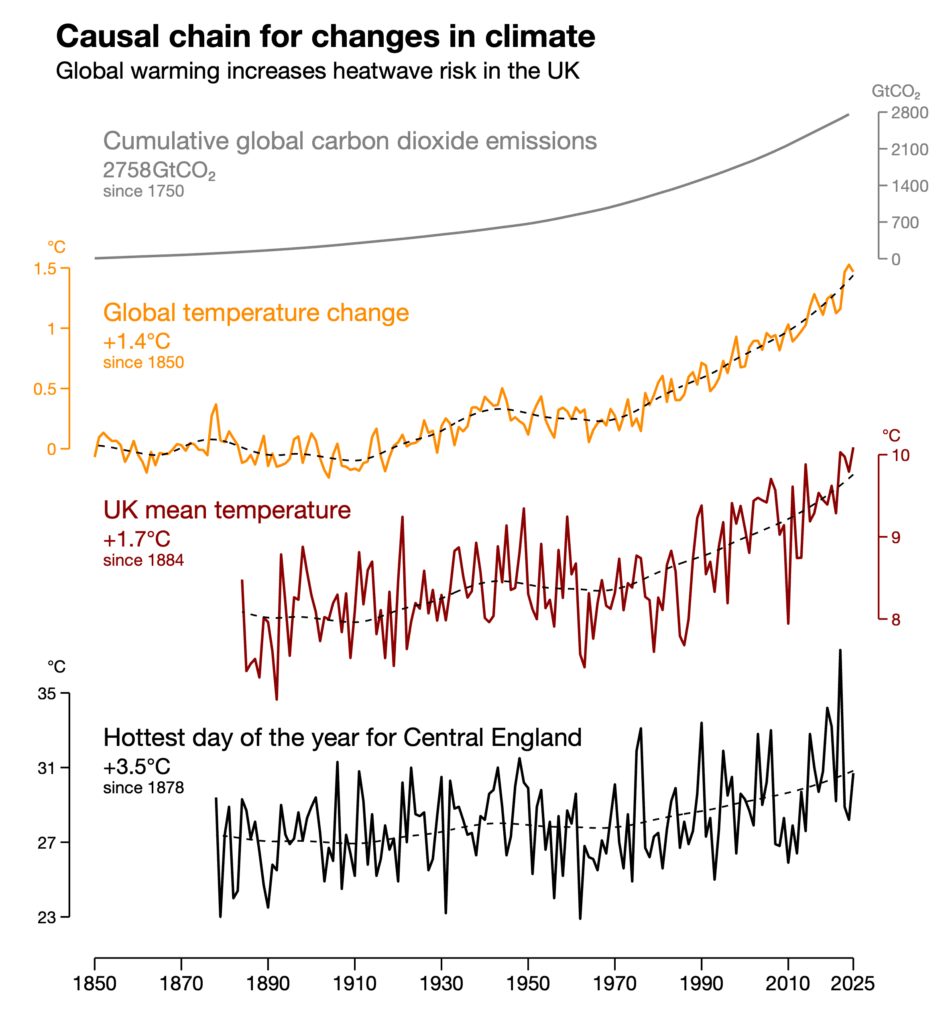
“Human actions have emitted over 2750Gt of carbon dioxide into the atmosphere, mainly due to burning fossil fuels and deforestation, enhancing the greenhouse effect and warming the planet. The UK is responsible for around 3% of those total cumulative emissions.
“Did you know that as a result of these global emissions the world has warmed by around 1.4°C and the UK by about 1.7°C?
“What is notable is that the hottest day of the year for Central England has warmed more than two times faster than the annual average, and is now around 3.5°C hotter than in the late 19th century.
“A global warming of “just” 1°C does not imply that every day is 1°C hotter everywhere. For the UK, and many other regions, the very hot extremes are warming much faster than the mean. This matters because it is those hottest days which often cause the worst impacts on health, ecosystems and infrastructure, and even wildfires.”
What is the causal chain for changes in climate, and how does global warming increase heatwave risk in the UK?
“By visualising weather and climate data alongside each other, we’re able to more clearly see the physically plausible connections between global carbon dioxide emissions, our world’s changing climate, and local extreme weather events like heatwaves.
“These data visualisations show a “causal chain”, which can be a useful tool for communicating about the consequences of climate action and inaction.
“Heatwaves are periods of abnormally hot weather usually lasting several days. Our hot weather is occurring on top of a warmer background climate, so every heatwave in the world is now made hotter and more likely to happen because of human-caused climate change.
“Many of 2025’s heat-related records are, of course, likely to be broken again soon. Like previous record years, 2025 will end up being a relatively cool year when looking back from the future. We’ve not seen anything close to the most intense heatwaves possible under today’s climate, let alone the ones we expect to see in the coming decades.
“Our choices today matter for determining how much warmer that future will be.”