
From cognitive science to climate computing: Jesse Alexander’s research placement on Scotland’s wildfires
Jesse Alexander, a graduate whose role at the Centre for Environmental Data Analysis combines science communication and technical computing, completed a 3-month cross-disciplinary research placement to improve predictions of wildfires in Scotland.
Working with Dr Ioana Colfescu, a climate data scientist at the National Centre for Atmospheric Science and University of St Andrews, Jesse used machine learning techniques and a wildfire prediction model.
We spoke to Jesse about his placement:
What was the placement about?
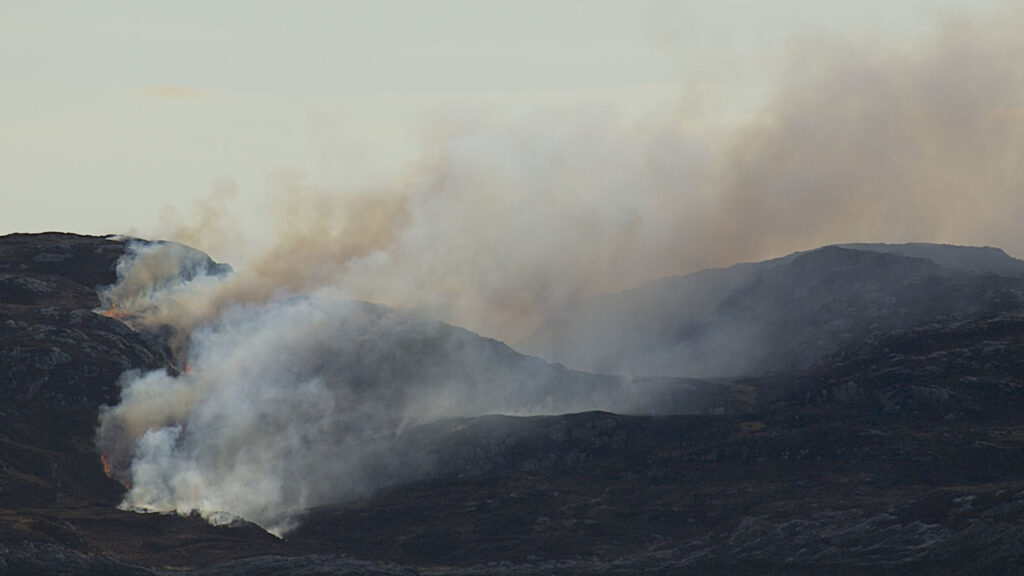
“My placement has been all about using machine learning models to research, model, and predict wildfires in Scotland. Scotland is not a country often associated with wildfires, despite a concerning increase in their occurrences over the past few years. Scottish wildfires have been historically under-researched and there is a noticeable lack of a fire danger warning system in place for Scotland. I found that as Scotland follows global warming and climate trends, the risk that wildfires pose to local infrastructure and natural habitats continues to increase.
“Without a background in wildfires or even environmental science, I started off by researching wildfires and Scottish occurrences specifically. I’ve been very lucky as Ioana connected me with Ophélie Georgina Marie Meuriot, a researcher at the Danish Technical University who has built and trained a wildfire prediction model alongside her colleagues which utilises machine learning.
“This model was designed for a region in Italy and was recently expanded to the rest of Western Europe. My role has been to take this model and attune it to Scotland, trailing different input datasets, customising land cover files and interpreting results.”
What motivated you to do this placement?
“I was very fortunate as a graduate at the Science and Technology Facilities Council, where CEDA is based, to have the opportunity to undergo a 3-month placement in a different department or organisation.
“My role at CEDA involves communicating to our users about the vast amounts of environmental data we have available and the JASMIN supercomputer we manage which facilitates climate research. My role is also shifting to a greater focus on improving the services we offer our users, and I thought the best way to understand our users’ needs was to become one myself!
“I figured that using our services as a researcher who requires access to our data and facilities would give me a better understanding of the journey a typical user might make from accessing and downloading data from the CEDA Archive to processing it on JASMIN.
“As someone who wouldn’t necessarily describe myself as a scientist, I was also really excited to experience proper research!”
How did you bridge the gap between your specialisms?
“I have quite a multi-disciplinary background and really enjoy connecting different areas of knowledge, having studied Cognitive Science at university, which is a mix between Computer Science and Psychology. I’m always really excited to be able to combine my specialisms and apply my knowledge from one domain to the other.
“I have definitely found it useful to work with colleagues from other disciplines. It’s highlighting the importance of collaboration and how useful it is to talk with other researchers and academics. There’s always something to be learned from every person you talk to!
“I have really enjoyed being able to utilise my computer science skills, which is something I’ve only done pieces of at my role at CEDA. And whilst I do have that background, working closely with my colleagues at JASMIN means I’ve got a lot of people I can ask if I get stuck on anything from using JASMIN to data access, which has proved to be an invaluable asset for my placement.”
What new skills did you develop?
“It opened my eyes to the importance of collaboration; I wouldn’t have been able to make nearly as much progress if I had had to build an ML model myself from the ground up. With the foundations already laid, I’ve really been able to hone my programming and machine learning skills. It’s also been a great experience doing tasks that might seem commonplace for most of our researchers, like accessing data from the CEDA Archive and processing and analysing this data on JASMIN.
“One of the big challenges has been getting used to the different ways of working between the two departments. At CEDA I’m often working on numerous projects at once and will often have to deal with tasks or requests that pop up. Research on the other hand can feel like climbing a mountain, putting in a lot of effort hiking to the top and realising you haven’t yet reached the peak!
“During my placement I could spend a week working towards one goal, and by the end it’s hard to feel like I’ve made much progress having just solved part of one problem. It’s quite a different experience from my regular role where I can achieve a number of ‘small victories’ throughout the week. Reminding myself that I’m still progressing, just not at the rate I’m used to has been vital, acknowledging that this is a new field for me and that I’m learning as I go.”
Has the placement influenced your thinking about future career directions or research opportunities?
“My placement has absolutely made me consider research as a future career path! Or at least encouraged me to explore ways that I can incorporate research into my future career. When there is so much to explore, it’s hard to sit back and wait to see if someone else is interested enough to research it themselves.
“I could not recommend a cross-disciplinary placement enough! It’s been amazing exploring a whole new side of the academic landscape, as I feel like I’ve learned loads and have a much better understanding of computing techniques I last learned about during my undergrad. I would really recommend choosing somewhere where you’ll explore a new field and different ways of working. A placement is the ideal opportunity to experience new domains and try different methods of working and research.”