
New African satellite weather facility launched with NCAS
A major new international initiative to transform weather forecasting and early warning systems across Africa has been launched, with the National Centre for Atmospheric Science playing a key scientific and technical role.
Severe weather events across parts of Africa have intensified in recent years, contributing to widespread flooding, damage to infrastructure, displacement and loss of life. Millions of people are affected annually, highlighting the need for more timely, accurate and actionable weather information.
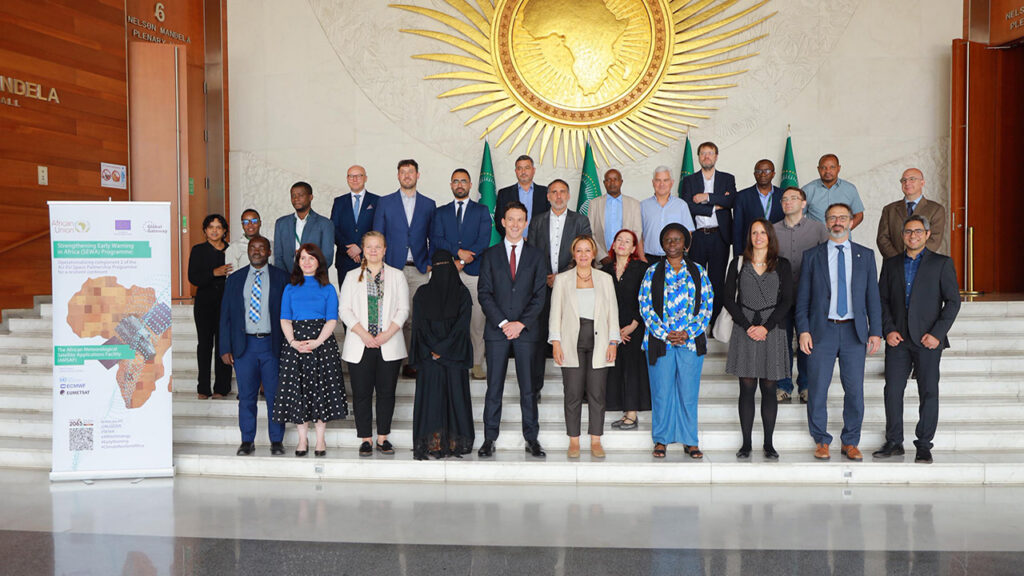
The African Meteorological Satellite Application Facility (AMSAF), officially launched on 18 May 2026 and supported by the European Commission’s Global Gateway, marks a significant step forward in harnessing next-generation satellite data to improve short-term weather forecasting – known as nowcasting – across the continent.
Advancing early warning capability across Africa
AMSAF has been designed to increase the capacity of African meteorological and hydrological services to access and use advanced satellite data in near real time.
The system will draw on satellite data, which provides high-resolution, rapid-update observations of weather systems across Africa. Using this data, AMSAF will support the production of highly localised forecasts covering a 0-6 hour timeframe – critical for anticipating severe weather events such as thunderstorms, flash floods and high winds.
A network of four regional centres will underpin the facility, with hubs located in Senegal, Kenya, Cameroon and South Africa. These centres, working with the African Centre of Meteorological Application for Development, will generate tailored weather products and distribute them to meteorological services across the African continent. The disseminated products will be a bespoke selection, aligned with regional priorities and national needs.
Translating science into impact
Researchers at the National Centre for Atmospheric Science (NCAS) and the School of Earth, Environment and Sustainability at the University of Leeds, are central partners in the AMSAF Technical Assistance Service Team (TAST). Alongside colleagues at the Finnish Meteorological Institute, Agencia Estatal de Meteorología, and Meteo Maroc, they are responsible for designing and implementing the technical systems that will enable AMSAF to operate effectively.
Dr Alex Roberts, a nowcasting research scientist at NCAS and the University of Leeds explains:
“Our role reflects a long-standing commitment to advancing meteorological science in Africa and ensuring that research translates into real-world impact. We have a strong track record in satellite-based nowcasting and capacity building, including contributions through programmes such as the Global Challenges Research Fund: African SWIFT initiative.
“Our earlier work helped to introduce nowcasting techniques in several African countries and demonstrated the value of collaborative “testbeds” in operational forecasting. These insights have directly informed the design of AMSAF, ensuring it is both scientifically robust and practically relevant.
“A related and award-winning output of the nowcasting work in Leeds is FASTA (the Forecasting African Storms Application), a digital platform developed by NCAS and partners that provides accessible, user-friendly tools for satellite-based nowcasting.”
Building sustainable capability and local ownership
Training and capacity building are at the heart of the AMSAF initiative. The TAST will work closely with regional hubs to support the installation, operation and maintenance of both local and cloud-based data processing systems. Forecasters and technical staff will receive training in using satellite data, generating forecasts and disseminating warnings effectively.
Importantly, the programme is designed to enable long-term sustainability and a transition towards full African ownership. By equipping regional and national institutions with the skills and infrastructure they need, AMSAF aims to create a self-sustaining system that continues to deliver benefits beyond the lifetime of the initial project.
The initiative is closely aligned with continental and global policy frameworks. It supports the African Union’s Multi-Hazard Early Warning and Early Action System and contributes directly to the United Nations’ “Early Warnings for All” initiative, which seeks to ensure that everyone on Earth is protected by early warning systems.
Disaster preparedness and economic resilience
The societal benefits of AMSAF are far-reaching. Improved nowcasting will enable governments, emergency responders and communities to act more quickly and effectively in the face of severe weather. This can reduce loss of life, limit damage to infrastructure and support more efficient disaster response.
Beyond emergencies, better weather information has significant implications for key economic sectors. Agriculture – which employs a large proportion of the population in many African countries – will benefit from more reliable short-term forecasts, helping farmers make informed decisions about planting, irrigation and harvesting. Similarly, sectors such as aviation, transport and energy will be better equipped to manage weather-related risks.
By strengthening resilience to climate variability and extreme events, AMSAF also contributes to long-term development goals, helping to safeguard livelihoods and support economic stability.
Aligning with UK industrial strategy and global goals
NCAS’s involvement in AMSAF highlights the UK’s role as a global leader in atmospheric science, earth observation and climate services. The project aligns strongly with the UK’s Industrial Strategy priorities, particularly in advancing science and innovation, strengthening international partnerships and supporting the growth of the space and data sectors.
Through collaboration with European and African partners, NCAS and the University of Leeds are helping to position UK expertise at the forefront of next-generation satellite applications. This enhances opportunities for knowledge exchange, innovation and future collaboration in the rapidly expanding global Earth observation market.
At the same time, AMSAF contributes to several United Nations Sustainable Development Goals – from climate action and sustainable communities, to zero hunger and international partnerships.
A step change in African weather services
The launch of AMSAF represents a major milestone in the evolution of weather services across Africa. By combining cutting-edge satellite technology with local expertise and strong international partnerships, the initiative is set to deliver a step change in forecasting capability.
With NCAS at its core, the programme exemplifies how UK science can support global development challenges – transforming data into decisions, and research into resilience for communities most exposed to extreme weather.
Acknowledgements
The African Meteorological Satellite Application Facility (AMSAF) is supported through the European Commission’s Global Gateway Africa-Europe Space Partnership Programme, under Component 2: Strengthening Early Warning Systems in Africa (SEWA).
SEWA is jointly implemented by the European Organisation for the Exploitation of Meteorological Satellites, European Centre for Medium-Range Weather Forecasts, and African Union Commission.
NCAS and the University of Leeds contribute to the AMSAF Technical Assistance Service Team.