
International ocean expedition is set to advance understanding of climate-critical marine emissions
Back in June, an international team of scientists embarked on a major marine research campaign to investigate how remote ocean environments influence the Earth’s atmosphere and climate system.
The expedition, led at sea by Dr Ming-Xi Yang of Plymouth Marine Laboratory, combines two complementary research programmes. COCO-VOC – led by Dr Ming-Xi Yang – focuses on ocean-emitted volatile organic compounds (VOCs). Meanwhile, CARES – led by Professor Alex Archibald of National Centre for Atmospheric Science and University of Cambridge – examines marine sulfur cycling. Together, these projects aim to quantify how gases and aerosols produced by the ocean affect atmospheric chemistry, cloud formation, and climate regulation.
Sailing from Southampton to the Cape Verde region, the National Oceanography Centre’s research vessel RRS Discovery provided a unique platform for studying ocean–atmosphere exchange across a range of marine environments.
Over a ten-day transit, followed by an intensive two-and-a-half-week study period, the team investigated conditions in both nutrient-poor ocean and more biologically productive coastal zones.
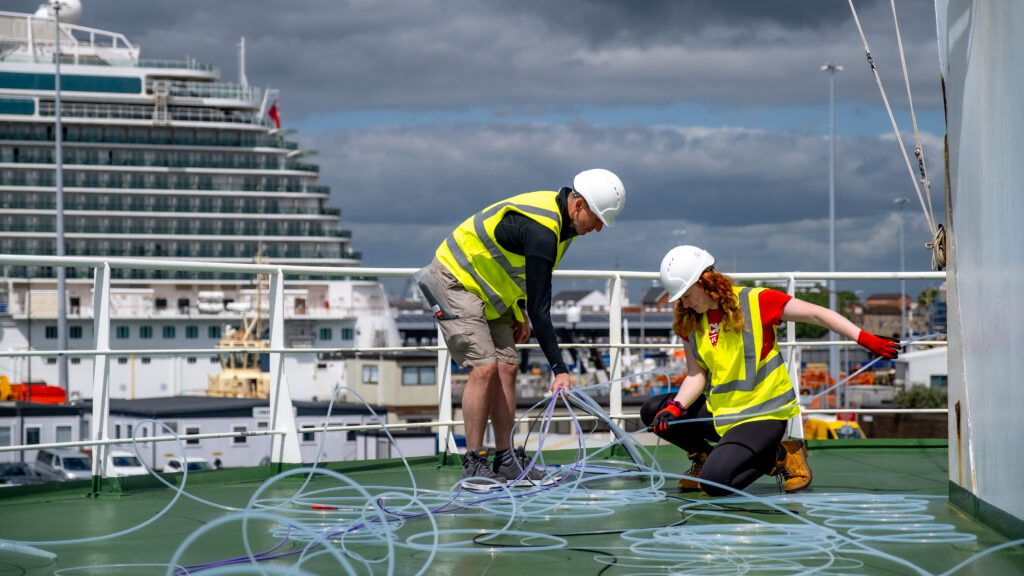
Researchers deployed an advanced suite of instruments onboard, housed in specialised containers across the ship. These measured a broad spectrum of atmospheric gases and aerosol particles, alongside ocean properties from the surface microlayer down to depths of 1000 metres.
A key focus of the work is sulfur chemistry, which plays a pivotal role in cloud formation. Marine sulfur compounds can contribute to aerosol production, influencing cloud reflectivity and lifetime – factors that are central to the Earth’s energy balance.
In parallel, the team studied VOCs emitted from the ocean and how they affect the lifetime of methane, a potent greenhouse gas.
This is a highly collaborative and integrative science project. By combining detailed atmospheric observations with ocean measurements, we aim to better understand how marine emissions shape atmospheric composition and climate processes.
– Dr Ming-Xi Yang, research scientist at the Plymouth Marine Laboratory (PML)
The campaign also provides an important training opportunity for early-career researchers, with a cohort of PhD students gaining hands-on experience in field measurements and interdisciplinary science at sea.
Dr Pete Edwards, a research scientist at NCAS and the University of York, emphasises the significance of the work: “These remote ocean processes have strong impacts on climate. Improving our understanding of how gases and particles are exchanged between the ocean and atmosphere will help us refine predictions of future climate change.”
The findings from this campaign are expected to enhance climate models and reduce uncertainties in projections of atmospheric composition and cloud dynamics. By advancing knowledge of remote marine environments – regions that are currently under-observed but globally influential – the project represents a critical step toward more accurate climate forecasting.
The project brings together expertise from NCAS, PML, and UK universities – including Leeds, York, and Manchester – alongside collaborators from the United States and Canada, in a coordinated effort to better understand marine emissions and their global impacts.
This collaborative effort underscores NCAS’s commitment to supporting cutting-edge research that addresses key challenges in understanding the Earth system and its response to environmental change.