
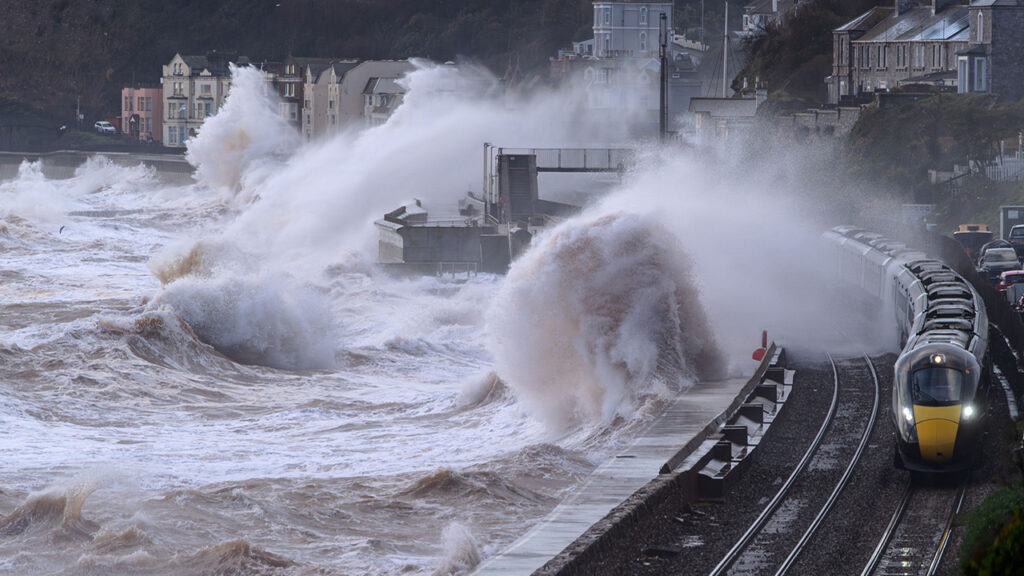
Everything you should know about storms
Throughout the year, low pressure weather systems frequently move across the UK, bringing clouds, rain, and wind. If the low pressure system is intense enough, it may become a named storm.
What is a storm?
Wind is the movement of air in our atmosphere.
Air is forced to move by differences in atmospheric pressure, and the Earth’s rotation means that the wind circulates around areas of lower pressure, known as a cyclone. If there is a greater difference in pressure, this causes stronger winds around the cyclone.
Storms often bring heavy rainfall that may lead to flooding. Storms move moisture around the atmosphere, which forces warm and moist air to rise. Wherever the warm, moist air rises, clouds are formed. The formation of clouds also releases energy which can further intensify the storm.
Why are storms named?
In the UK, a storm is given a name when it has the potential to cause disruption or damage as a result of strong winds, heavy rainfall or snow, leading to amber or red weather warnings being issued.
In Europe there are three storm naming groups, and each September there is a new alphabetical list of names issued for the upcoming storm season. The UK storm season begins in September and ends in August the following year.
Storms can impact many countries at once, and to avoid confusion, the UK adopts a storm name if another European weather service has already named it.
What causes storms in the UK?
The UK is renowned for being stormy, and it’s because of the jet stream. The jet stream is a core of strong winds around 8-11 km above the Earth’s surface, blowing from west to east, which directs storms across the Atlantic to the UK.
As the jet stream moves storms across the Atlantic, they can draw up more and more moisture, and that’s why storms often bring heavy rainfall to the UK.
What about climate change?
Storms tend to vary naturally in intensity and frequency on an annual basis – this makes identifying trends in storms particularly challenging. However, links between human-caused global warming and storms should be expected.
A warming atmosphere is linked with heavier rainfall, because the air is able to hold more moisture – and leads to clouds containing a greater number of larger raindrops.
As the climate continues to warm, the effect will increase, and storms with heavy rain are expected to become more common. Additionally, the extra release of energy by clouds will likely lead to an increased rate of storms that rapidly intensify and a strengthening of the most extreme storms.
As human-caused climate change continues to warm the atmosphere, the air is able to hold more moisture. This leads to more condensation in clouds, releasing more energy and intensifying storms. The result is that storms with heavy rain are expected to become more common, and storms with strong surface winds may be more damaging.
Dr Ben Harvey, research scientist at the National Centre for Atmospheric Science and University of Reading
The most damaging UK storms tend to be those which intensify quickly, known as explosively deepening cyclones, and these are particularly sensitive to the availability of moisture to fuel their development. But other factors also contribute to the storminess of the UK. For example, the large-scale temperature contrast between the sub-tropical and polar air masses is decreasing as the Arctic rapidly warms. This is expected to contribute to fewer storms overall, even if the most extreme storms intensify.
Dr Ben Harvey, research scientist at the National Centre for Atmospheric Science and University of Reading