
What do wildfires mean for air quality?
With prolonged hot weather, and wildfires burning across the UK and Europe, what does this mean for air quality in the affected areas or places downwind?
Heatwaves create prolonged dry conditions that make wildfires more likely. Extended periods of hot weather dry out vegetation and soil, making it easier to ignite and sustain a fire. In the UK, this is particularly relevant for moorland areas, where peat soils can begin to burn when conditions are dry enough. Once ignited, peat fires can be extremely difficult to extinguish.
Wildfires can endanger lives and cause extensive damage to ecosystems, property and livelihoods. They also have significant impacts on air quality. Wildfire smoke contains a mixture of hazardous air pollutants, including fine particulate matter, nitrogen oxides, and volatile and semi-volatile organic compounds.
People living close to a fire, as well as emergency responders, can be directly exposed to these pollutants. However, the effects can extend far beyond the immediate area, as smoke and pollutants can be transported by the wind across entire regions, impacting people many miles away.
In addition to their impacts on health and the environment, wildfires can also influence the climate on regional and even global scales. Fires release large quantities of carbon dioxide, organic and black carbon and ozone precursors into the atmosphere, contributing to climate change and affecting atmospheric chemistry.
As climate change increases the frequency and intensity of heatwaves, the conditions that drive wildfires are expected to become more common. This highlights the need for prevention, preparedness and response strategies that consider not only the direct risks posed by wildfires, but also the wider impacts on air quality, public health, and the climate. Understanding these interconnected challenges is essential for effective long-term planning in a warming world, and integrated approaches to environmental monitoring and risk management.
Although air quality in the UK has improved significantly in recent decades, air pollution remains responsible for tens of thousands of premature deaths each year and continues to place a substantial burden on health services and the economy. As temperatures rise and extreme weather events become more frequent, there is a growing need to understand how future climate conditions could influence air pollution levels and public exposure.
NCAS research is helping to provide this understanding by examining how climate change, heatwaves, wildfires and air quality interact across different timescales and regions. Through advanced atmospheric measurements, modelling, long-term monitoring, and toxicology studies, NCAS is generating the evidence needed to support more informed decision-making, from local air quality management and public health planning to national climate adaptation and resilience strategies.
In the UK, air quality is monitored through a network of sites operated by DEFRA and local authorities, which primarily measure legally regulated pollutants such as PM2.5, ozone and nitrogen dioxide. Complementing this network is a smaller number of atmospheric ‘supersites’, operated in partnership with national research organisations and universities, which provide much more detailed observations of the atmosphere and a wider range of pollutants.
NCAS currently operates three urban supersites in Manchester, Birmingham and London in partnership with DEFRA. These facilities provide the high-quality measurements needed to improve understanding of pollutant sources, track how air quality responds to changing weather and climate conditions, and strengthen the evidence base used to assess future environmental risks and guide policy decisions.
Case study: The impacts of Dovestone and Tintwistle wildfires on air quality in Manchester during July 2026
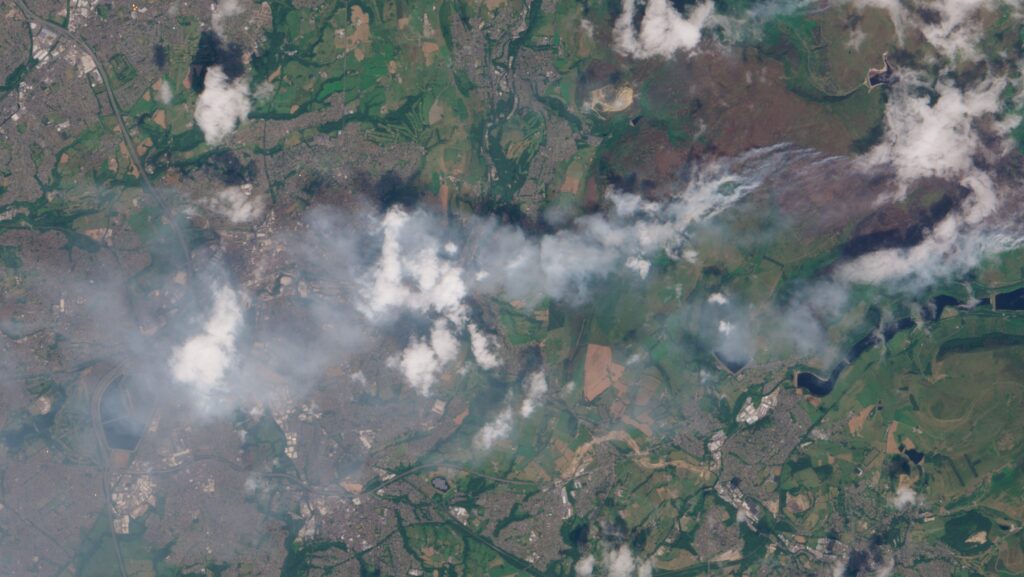
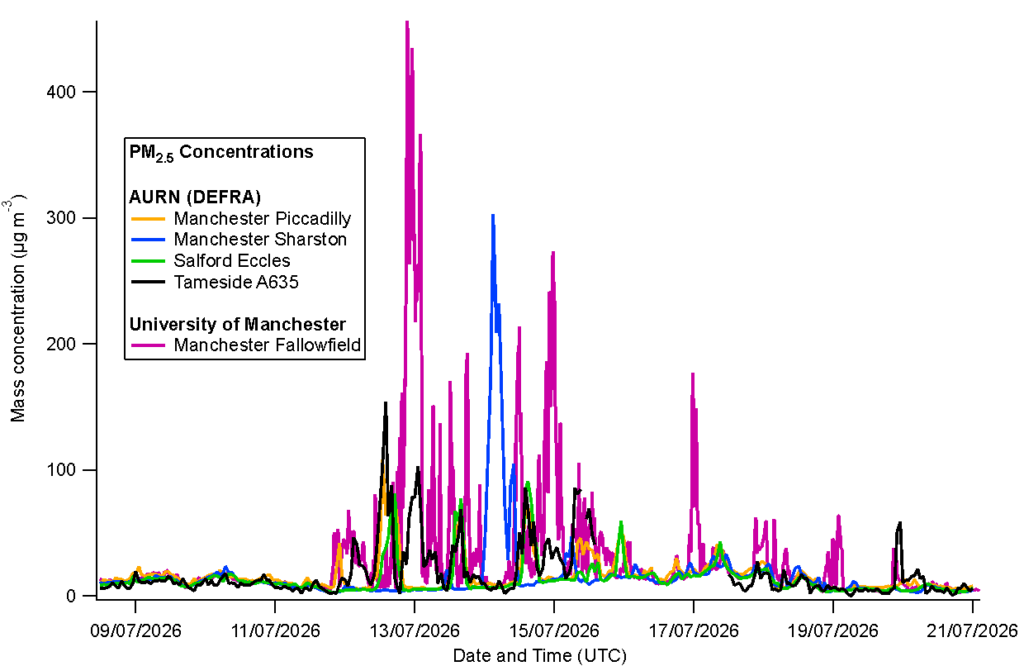
Following prolonged heatwaves and dry weather, major wildfires at Tintwistle Moor and Dovestone Reservoir in July 2026 produced smoke plumes that were carried into Greater Manchester by easterly winds. Air quality monitoring stations across the city detected significant increases in pollution, particularly between 12 and 15 July.
The most notable impact was on fine particulate matter (PM₂.₅). While typical annual average concentrations in Manchester are below 10 µg m⁻³, some locations recorded levels exceeding 100 µg m⁻³ for several hours. At the Manchester Air Quality Supersite (MAQS), the smoke was found to consist predominantly of very small particles and organic matter, characteristics consistent with peat and biomass burning.
PM₂.₅ concentrations exceeded the World Health Organization’s 24-hour guideline value for an extended period between 11 and 18 July. This is important because evidence suggests wildfire smoke can have greater health impacts than equivalent levels of particulate pollution from typical urban sources.
The wildfire event demonstrated how prolonged moorland fires can affect air quality far beyond the fire zone and highlighted the importance of comprehensive monitoring networks in understanding and responding to wildfire smoke episodes.
The graph shows levels of fine particulate detected at the Manchester air quality monitoring stations and the Manchester Air Quality Supersite from 9 July – 21 July 2026, with concentrations at all sites rising above typical levels.
Featured image credit: Copernicus Sentinel data 2026, showing wildfire smoke blowing towards the Greater Manchester area in July 2026.