
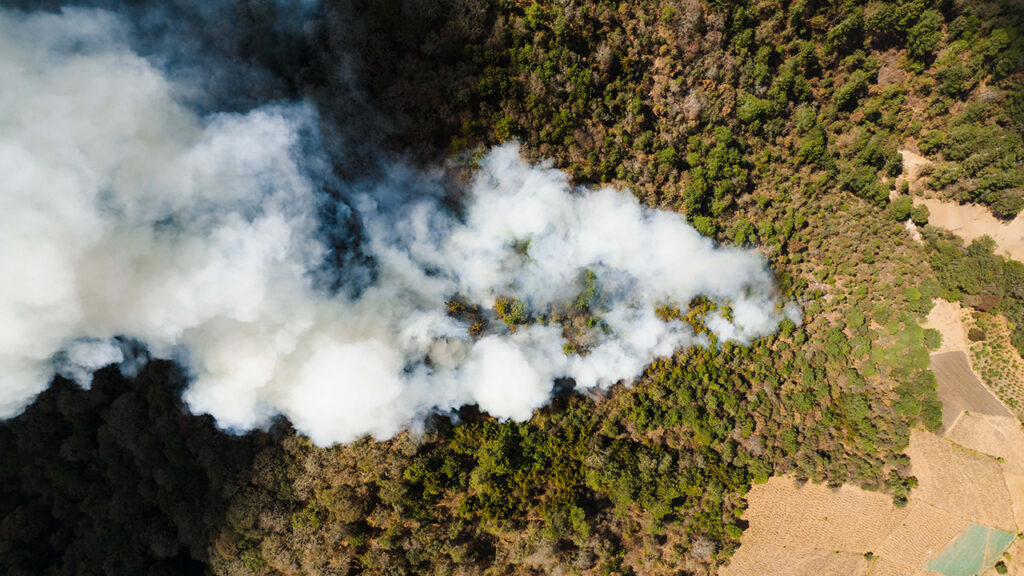
What do wildfires mean for climate change?
With prolonged hot weather, and wildfires burning across parts of Europe and North America, what do these events mean for the climate?
Feedback loop of wildfires and climate change
Wildfires are a natural part of many ecosystems, but human-driven climate change (primarily caused by burning fossil fuels) is making large and severe fires more likely. Higher temperatures, changes in rainfall patterns, and more frequent heatwaves can dry out vegetation and soils, creating landscapes that are more susceptible to burning.
The two-way relationship between wildfires and climate change is complex.
Climate change can increase wildfire risk, but wildfires can also contribute to climate change by releasing greenhouse gases and other pollutants into the atmosphere and by triggering vegetation changes. This creates a feedback loop in which warmer conditions increase the likelihood of fires, and fires in turn contribute to further warming.
Forest fires, grassland fires, and climate impacts
Forests, peatlands, and other carbon-rich ecosystems store vast amounts of carbon in their vegetation and soils. When these ecosystems burn, some of that stored carbon is released into the atmosphere as carbon dioxide and methane, contributing to climate change.
The climate impact of wildfires is driven largely by forest fires because forests contain such substantial carbon stocks. As global temperatures rise and precipitation patterns shift, forest fires are becoming more frequent and widespread, increasing the amount of carbon released into the atmosphere.
The total area of land burnt annually is actually dominated by grassland fires, and the area burnt each year has been decreasing because of land use change in Africa. Grassland fires release significant amounts of carbon into the atmosphere, but much of the ecosystem’s carbon remains safely stored underground in roots and soils. When a fire sweeps through, it primarily burns above-ground vegetation.
In healthy ecosystems, much of this carbon can eventually be reabsorbed as vegetation regrows following a fire or in the next growing season. This is part of the natural fire-recovery cycle. However, where fires become more frequent, more severe, or are followed by land-use change, recovery can be slow or incomplete. In these cases, carbon that was previously stored on land can remain in the atmosphere for decades or longer, contributing to climate change.
Wildfires also release large quantities of aerosol particles. One of the most important of these is black carbon. Black carbon absorbs sunlight and can cause short-term warming of the atmosphere. When deposited on snow and ice, it darkens the surface, causing it to absorb more solar radiation and melt more quickly.
Wildfire emissions can influence regions far from the original fire. For example, wildfires in eastern Siberia have contributed to elevated levels of black carbon in the Arctic, and smoke from fires in the Amazon has been linked to decreased albedo and increased melting of glaciers in South America. These impacts demonstrate how wildfire emissions can affect climate processes on regional and global scales.
The impacts of wildfires extend beyond greenhouse gas emissions alone. Smoke particles interact with sunlight and clouds, affecting atmospheric chemistry and weather patterns. Quantifying the effects of wildfires on the climate remains challenging because the amount and composition of emissions vary considerably depending on the type of vegetation burning, fuel conditions, fire behaviour, and weather conditions.
The role of research in understanding wildfires in a changing world
As wildfires become more frequent and severe in a warming climate, understanding their long-term impacts is increasingly important. Scientists are working to improve estimates of wildfire emissions, understand how wildfire smoke interacts with the atmosphere, and assess how changing fire regimes may influence future climate.
Understanding these interconnected processes is essential for informing climate mitigation, adaptation and environmental risk management. As climate change continues to alter fire-prone regions around the world, evidence-based approaches will be critical for reducing risks and building resilience to future wildfire events.
NCAS research helps improve understanding of the links between wildfires, atmospheric chemistry, air pollution, and climate change. Through advanced atmospheric measurements, Earth observation, modelling and long-term monitoring, NCAS scientists can track wildfire emissions, assess their impacts on atmospheric composition, and improve predictions of how wildfire activity may change in the future. This evidence can help policymakers and environmental agencies better understand climate risks, evaluate mitigation strategies, and strengthen adaptation planning in a warming world.