
El Niño explained: Global weather, UK impacts, and climate change
El Niño is one of the most important climate patterns affecting weather across the globe. It shapes temperatures, rainfall and extreme events – with impacts that extend to economies, infrastructure and human health.
El Niño conditions are currently developing, with it likely to start in the summer and continue into the autumn, confirmed by the World Meteorological Organisation.
What is El Niño?
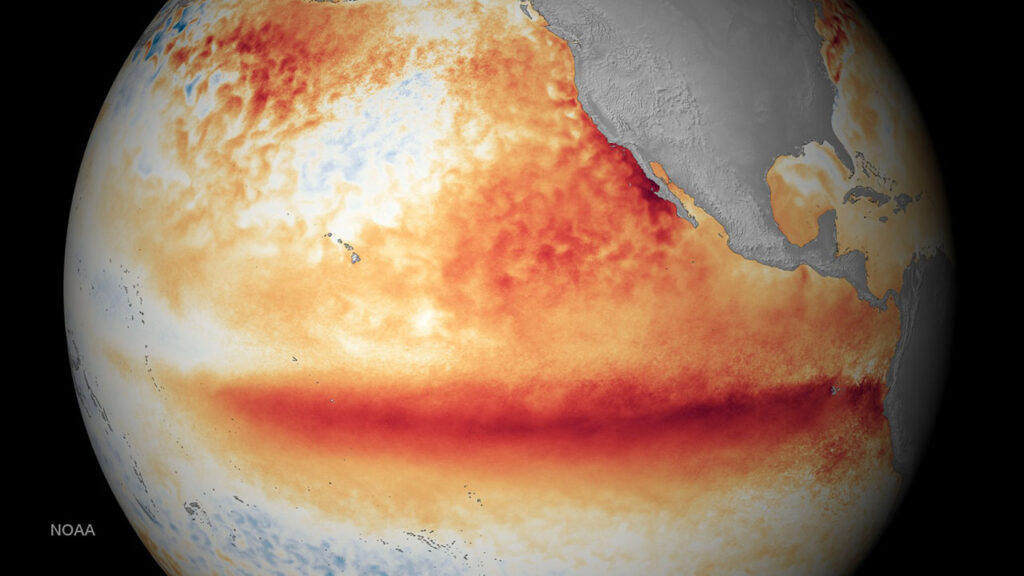
El Niño is a natural climate pattern linked to unusually warm ocean temperatures in the Pacific. It occurs irregularly every two to seven years, typically lasts around one year, and can push global temperatures higher in the year that follows.
How does it develop?
In normal conditions, trade winds push warm water westward across the Pacific, allowing cooler water to rise in the east. During El Niño, these winds weaken, allowing warm water to shift eastwards. An event is typically identified when ocean temperatures rise at least 0.5°C above average in the eastern equatorial Pacific.
A global driver of weather
El Niño is not just an ocean phenomenon. It acts like a giant heat source in the tropics, shifting winds, rainfall and the large-scale global atmospheric circulation. As a result, it can change weather patterns worldwide, driving extremes in different regions and in different seasons. Stronger events can lead to greater disruption, and can warm the planet by around 0.2°C on average over a year.
El Niño tends to suppress rainfall over most tropical land. This means that Asian, African, and South American monsoons tend to be drier than usual. It is also associated with increased rainfall, and can lead to severe flooding, in the southern United States, Peru, Argentina, southern Europe, and East Africa. El Niño can also exacerbate heatwaves in the tropics.
Impacts beyond temperature
El Niño’s impacts extend well beyond global averages. It can affect:
- Global food supply and prices, particularly through drought
- Global economies, especially for regions dependent on agriculture and fishing
- Regional infrastructure, due to flooding and extreme weather
- Health, including risks linked to heat, disease and food insecurity
What about the UK?
In the UK, El Niño’s effects are less severe, but still important. It can influence winter weather patterns, alter storm tracks and create knock-on impacts via global supply chains.
Recent global temperature impacts
The most recent El Niño occurred in 2023–2024 and contributed to exceptionally high global temperatures. While long-term warming is driven primarily by human-induced climate change, El Niño can amplify global heat, helping to push temperatures to record levels.
Are there any benefits of El Niño?
The southern United States and Peru can experience increased rainfall, which is potentially beneficial for agriculture. Additionally, El Niño can lead to milder winters in parts of the northern United States, Canada, and central Europe, reducing heating costs and making conditions safer for travel. El Niño is associated with reduced hurricane frequency in the North Atlantic, but an increased frequency in the East Pacific. One of the potential benefits of drier monsoons during El Niño is reduced malaria risk.
El Niño in a warming world
The role of climate change on El Niño remains unclear. Observations show an emerging weak trend towards cooler sea surface temperatures in the tropical Pacific Ocean. In climate model studies, some show increased El Niño frequency and intensity, some decreased, and some have no significant change. Statistical studies that have looked at the historical relationship between El Niño and climate change agree that the frequency of El Niño has increased in recent years, but the consensus is that this is caused by natural variability, rather than global warming.
El Niño is a natural part of the climate system, but its impacts are changing. Rising background temperatures due to human-driven climate change mean that when El Niño occurs, it can contribute to more intense heat and more extreme conditions, and be a driver of real-world impacts on societies and economies worldwide. This year’s El Niño will be occurring against a backdrop of record global temperatures.