

What do heatwaves mean for air quality?
A second record-breaking heatwave has hit the UK this year. Besides bringing risks to the environment, infrastructure, and people’s physical and mental health, heatwaves also affect the quality of the air we breathe.
Air pollution levels are closely linked to the weather, and hot spells often arrive hand-in-hand with poor air quality.
With climate change making heat waves more likely, we must consider the different ways that rising temperatures will affect us, including the air we breathe.
– Dr James Allan, NCAS’s lead scientist for air pollution research
We spoke to James to learn more about the impacts of heatwaves on air quality.
How do heatwaves affect air quality?
Heatwaves are periods of abnormally hot weather lasting at least three days.
They are most common when long-lasting high pressure weather systems develop during the summer, leading to clear skies and generally settled, dry weather.
“Heatwaves are known to affect air quality in a number of ways. As soils dry out, the air can carry more wind-blown dust. Also, dry summer vegetation makes it more likely for wildfires to occur, particularly when people spend more time outdoors in the countryside. While many global headlines focus on forest fires, the UK is also susceptible to moorland fires – something that recently prompted the government to create two new wildfire bases in the north of England. The air quality impacts of wildfires can be severe for those downwind,” says James.
He continues: “The hot and sunny weather is also known to promote the creation of harmful ‘secondary air pollution’ through atmospheric chemical reactions. Pollutants emitted within the UK and mainland Europe, such as oxides of nitrogen (known as NOx) and non-methane volatile organic compounds (VOCs), react with sunlight to form ozone and secondary particulate matter. The increased temperature can increase VOCs that come from evaporation, or promote natural plant activity. Higher temperatures and sunlight means the atmospheric chemistry progresses faster, and the winds from the south mean that the UK experiences the processed emissions from mainland Europe and beyond.”
How is air quality monitored in the UK?
James explains:
“Air quality in the UK is monitored by a network of sites operated by DEFRA and local governments, but these are usually limited to making measurements of the legally-binding pollutants such as PM2.5 (fine airborne particulate matter), ozone and nitrogen dioxide.
“In addition to these, a smaller network of ‘supersites’ is operated in partnership with National Research Organisations and universities to make more detailed measurements of air pollutants. These will provide insights into the sources and processes affecting air quality, and equip us with the knowledge to better manage and predict pollution in the future. Currently, three urban supersites at Manchester, Birmingham, and London are operated by NCAS and DEFRA.”
What is the latest data showing?
“When analysing the composition of PM2.5, a striking trend can be seen when analysing data from previous heatwaves. As temperatures increase, an increase in the PM2.5 concentration is seen, but it is also evident that the PM2.5 consists almost entirely of organic matter. This behaviour is replicated across all three measurement supersites, in Manchester, Birmingham, and London, implying it is a country-wide phenomenon. The organic matter is likely secondary, produced through enhanced photochemistry and VOC emissions,” explains James.
He adds: “This is really interesting, because there is evidence to suggest that this type of PM2.5 may be more toxic. However our current level of scientific understanding and ability to predict organic matter PM2.5 is poor compared to other types of PM2.5. It is this uncertainty that motivates some of the air pollution research going on at NCAS. In addition to detailed measurements of PM2.5, trace gases and VOCs at the supersites, we are also conducting laboratory studies and developing state-of-the-art modelling tools.
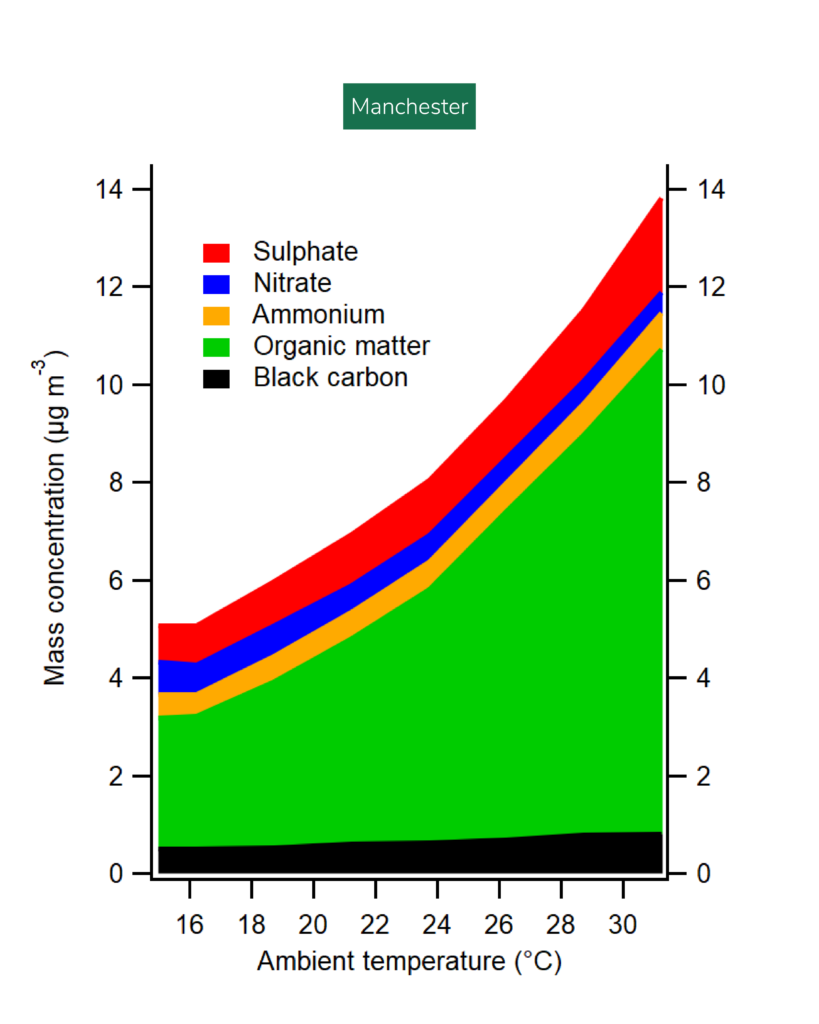
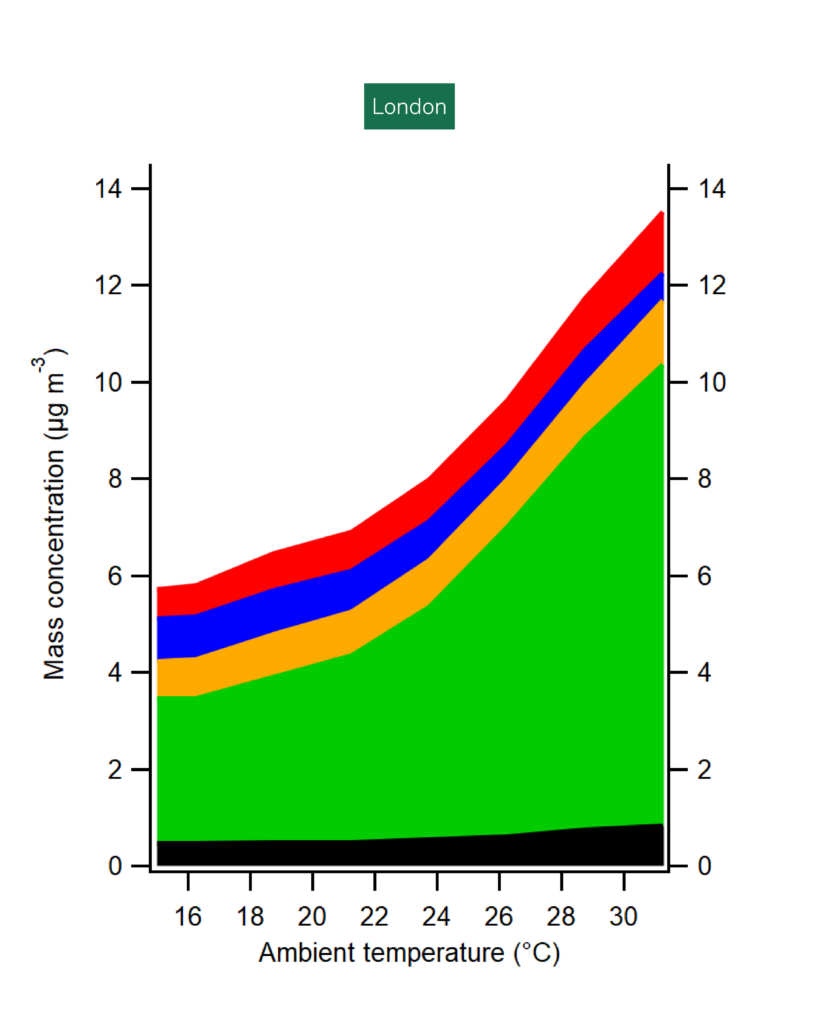
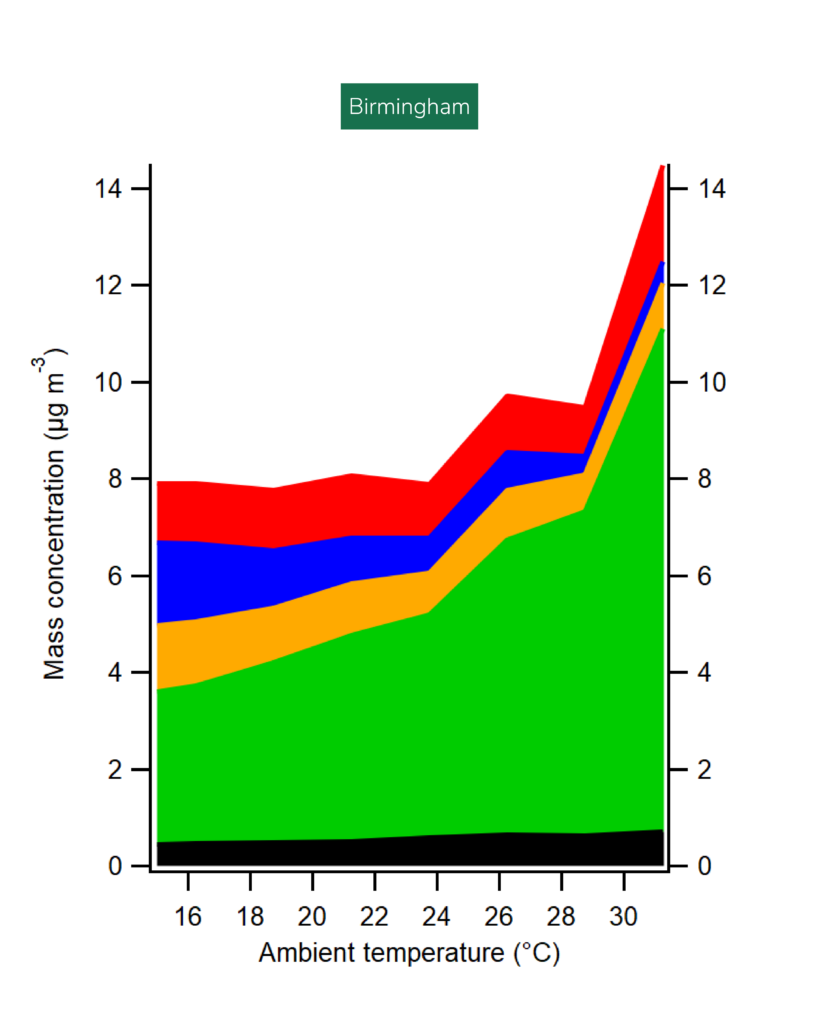
In Manchester, London, and Birmingham, the concentration of PM2.5 in the air increases as temperature rises. Shown in green, it is clear that organic matter contributes most to the PM2.5 levels. The PM2.5 data presented in these graphs is from 2019 and 2026, and shows average concentration levels across a range of ambient temperatures.
“While air quality continues to improve at a national level, air pollution is still responsible for tens of thousands of deaths within the UK. Continued improvement to the air we breathe will benefit people’s health, the burden on the NHS, and the overall economy. NCAS’s ongoing work will allow us to inform better planning for air pollution in a warmer future,” highlights James.