
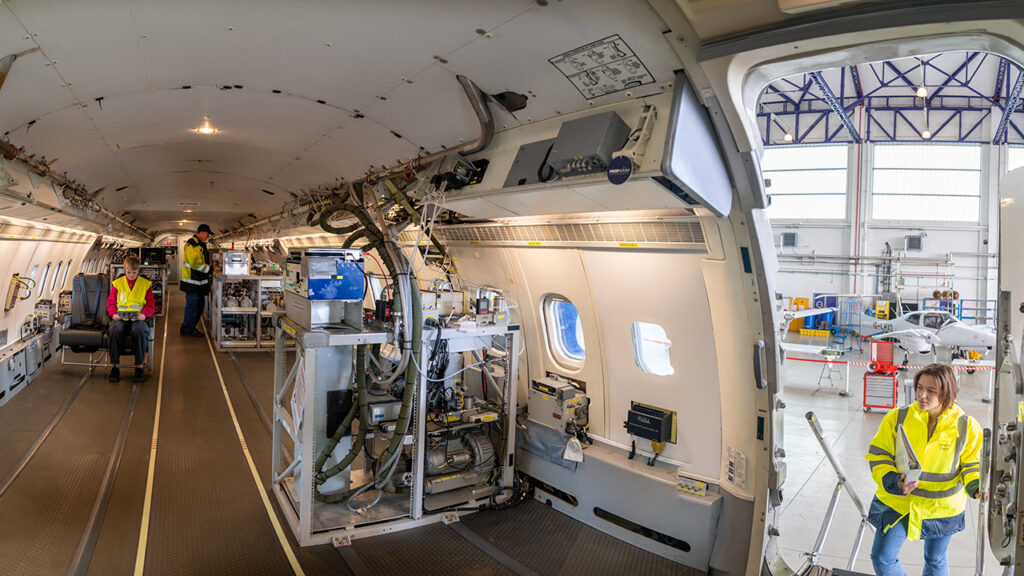
New fire extinguishers to reduce ozone-depleting equipment on our atmospheric research aircraft
We are replacing fire extinguishers on board the FAAM Airborne Laboratory’s atmospheric research aircraft to comply with a government directive aimed at reducing ozone depleting substances (ODS).
What’s involved in replacing our fire extinguishers?
Despite our aircraft being exempt from the directive and the similar EU law due to come into force at the end of the year, we are replacing three BCF (Bromochlorodifluoromethane, also known as Halon 1211 or Freon 12B1) extinguishers in the aircraft cabin. The aircraft is currently undergoing its semi-annual C-check, an ideal opportunity to make these kinds of changes.
Everything on the aircraft must be certified before the aircraft can fly. This means that fitting new equipment or replacing outdated equipment is not as straightforward as simply swapping one part for another. As we regularly change the equipment we carry in order to meet the scientific needs of a project (known as a configuration or config change), we have to certify each piece of new equipment. Our fire extinguishers are no exception so we have contracted an external design organisation to provide the certified modification, working with our Continuing Airworthiness Management Organisation (CAMO) Airtask Ltd to do so.
Alongside the cabin fire extinguishers we carry water extinguishers, fire gloves and bags and other equipment essential in the event of a fire onboard. Staff are also trained in airborne firefighting through carrying out drills in a simulated smoke filled cabin.
Why are we replacing the fire extinguishers?
Aircraft carry critical safety equipment, and some of this equipment has historically contained ODS. One such example is the fire extinguishers in the aircraft cabin. ODS gases are chemicals that destroy the earth’s protective ozone layer.
Since 1989, the production of ODS has been limited by the Montreal Protocol, the first universally-ratified treaty in United Nations history. Since it has come into effect, concentrations of ODS in the atmosphere have mostly either leveled off or decreased, and the treaty is expected to contribute to preventing millions of cases of certain kinds of cancer, among other direct human health benefits.
The FAAM Airborne Laboratory’s research aircraft is classed as an Annex 1 (non-Part 21) aircraft by the Civil Aviation Authority, and is therefore exempt from following the directive to remove ODS from aircraft. We are voluntarily replacing the fire extinguishers anyway to minimise our impact on the environment.