

Whirl-puffs, welkin, and weathermongers: The history of weather language
The language we use to describe the weather feels familiar, but behind everyday words like temperature, storm, and forecast lies a global history stretching from ancient roots to modern science.
Two recent papers written by Dr Kieran Hunt, a meteorologist at the National Centre for Atmospheric Science and University of Reading, trace this evolution, revealing how meteorological English grew from lived experience into a precise scientific language – and why it still carries echoes of its past.
In its earliest form, meteorological English was built for survival, not science. Words were grounded in what people could feel (wind, rain, and storm) and what they needed to survive.
Early English speakers used experience-based vocabulary to describe the atmosphere – terms shaped by farming, sailing, and exposure to the elements. At this stage, meteorological language was practical and rooted in the natural world rather than influenced by scientific measurements.
For example, the Old English word weder encompassed many of the meanings associated with weather today, but could also refer to wind, air or storms.
As English speakers travelled the world for exploration, trade, and colonial expansion, they encountered new climates, phenomena, and languages.
Words describing unfamiliar climates and extreme events were borrowed and adapted with English absorbing influences from many cultures. English vocabulary expanded dramatically through this contact.
The history of weather vocabulary therefore also reflects a history of global contact. Weather words became linguistic souvenirs of contact between different societies.
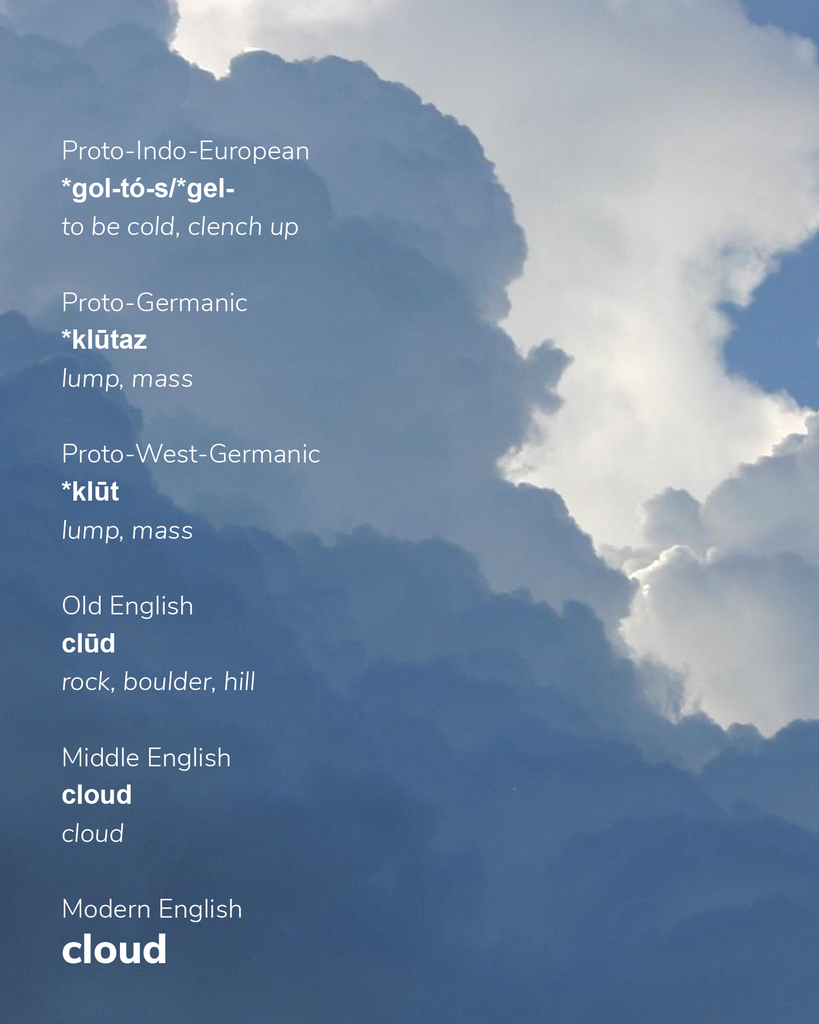
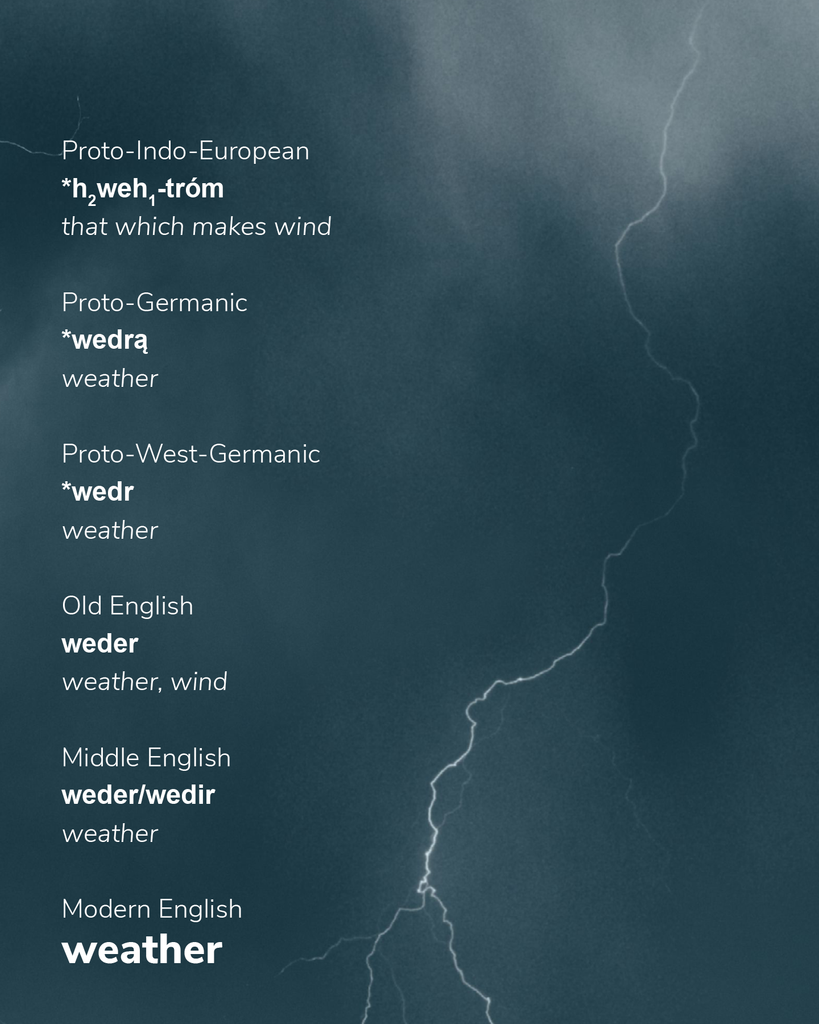
Even today, commonly used terms for tropical weather systems reflect this language contact.
The biggest shift in meteorological English came with the rise of modern science in the 17th and 18th centuries.
As atmospheric observation became systematic, scientists needed new terms and more precise meanings for existing terms to describe what they were measuring. The result was a surge of technical terms, and many were borrowed from Latin and Greek.
Words we now take for granted were once innovations. Temperature originally referred to temperate or moderate conditions before being redefined as a measurable quantity. Pressure originally described pain or bodily discomfort before Robert Boyle applied it to a physical quantity in 1660. Humidity entered English from Latin roots relating to moisture and wetness.
Weather was no longer just experienced; it was measured, recorded and predicted. And as meteorology developed into a formal science, its vocabulary became more standardised and widely shared. Growing observational networks and scientific understanding required consistent terminology – enabling communication between researchers, forecasters and the public.
At the same time, older meanings did not disappear entirely. Many words retained traces of their earlier uses, giving modern meteorological English its layered character.
Understanding how meteorological English developed reveals how people have made sense of the atmosphere across time.
From practical observation to scientific measurement, each stage of language reflects a different way of knowing the weather. Meteorological English is still evolving, just like the atmosphere itself. And as climate science and forecasting continue to advance, new words, and new meanings, will inevitably emerge.
For researchers at NCAS and beyond, this history is a reminder that communication is central to science. The words used to describe weather shape how it is understood, not just by scientists, but by society.